Standing Desks for Sensory-Sensitive Workspaces
This site contains affiliate links. If you purchase through our links, we may earn a commission at no extra cost to you. We only recommend products we'd use ourselves.
If you've ever abandoned a standing desk because the motor whine was just enough to make focused work impossible, this review is for you. Most desk coverage talks about weight capacity and tabletop finish. We tested for the things that actually matter when your nervous system has opinions: how loud the motor is, what frequency it runs at, how fast the desk moves, and whether the control panel requires a moment of cognitive archaeology every time you want to switch positions.
We evaluated four desks across those dimensions. Not one of them is perfect. But the gaps between them are meaningful, and they matter for different reasons depending on how your brain works.
All four desks reviewed here are dual-motor frames with memory presets. Single-motor frames weren't considered—the wobble at standing height is a sensory distraction that compounds over a workday in ways that are hard to explain until you've experienced it.
What We Tested For
Motor noise (dB level and tonal quality), transition speed, wobble at standing height, control panel feedback, and surface texture. Our full methodology is at Our Framework. The key thing to know: volume and pitch are separate problems. A 44dB hum at a low frequency is often more tolerable than a 42dB whine that sits in the range your brain flags as alerting. We measured all noise at seated ear height (~48 inches from the floor).
Quick Comparison
| Desk | Price Range | Motor Noise | Transition Speed | Wobble at Max Height | Control Panel | Best For |
|---|---|---|---|---|---|---|
| UPLIFT V2 | $599–799 | ~42dB (low hum) | ~3.5 sec | Minimal | Tactile presets, clear feedback | Best all-around |
| FlexiSpot E7 Pro | $449–599 | ~41dB (low hum) | ~4 sec | Minimal | Busier panel, softer buttons | Budget-friendly stability |
| Fully Jarvis | $449–649 | ~44dB (higher pitch) | ~3 sec | Slight at max height | Simplest panel available | Minimal cognitive load |
| UPLIFT V2 Commercial | $849–1099 | ~38dB (near-silent) | ~3.5 sec | None | Same as V2, premium build | Maximum quiet and stability |
UPLIFT V2
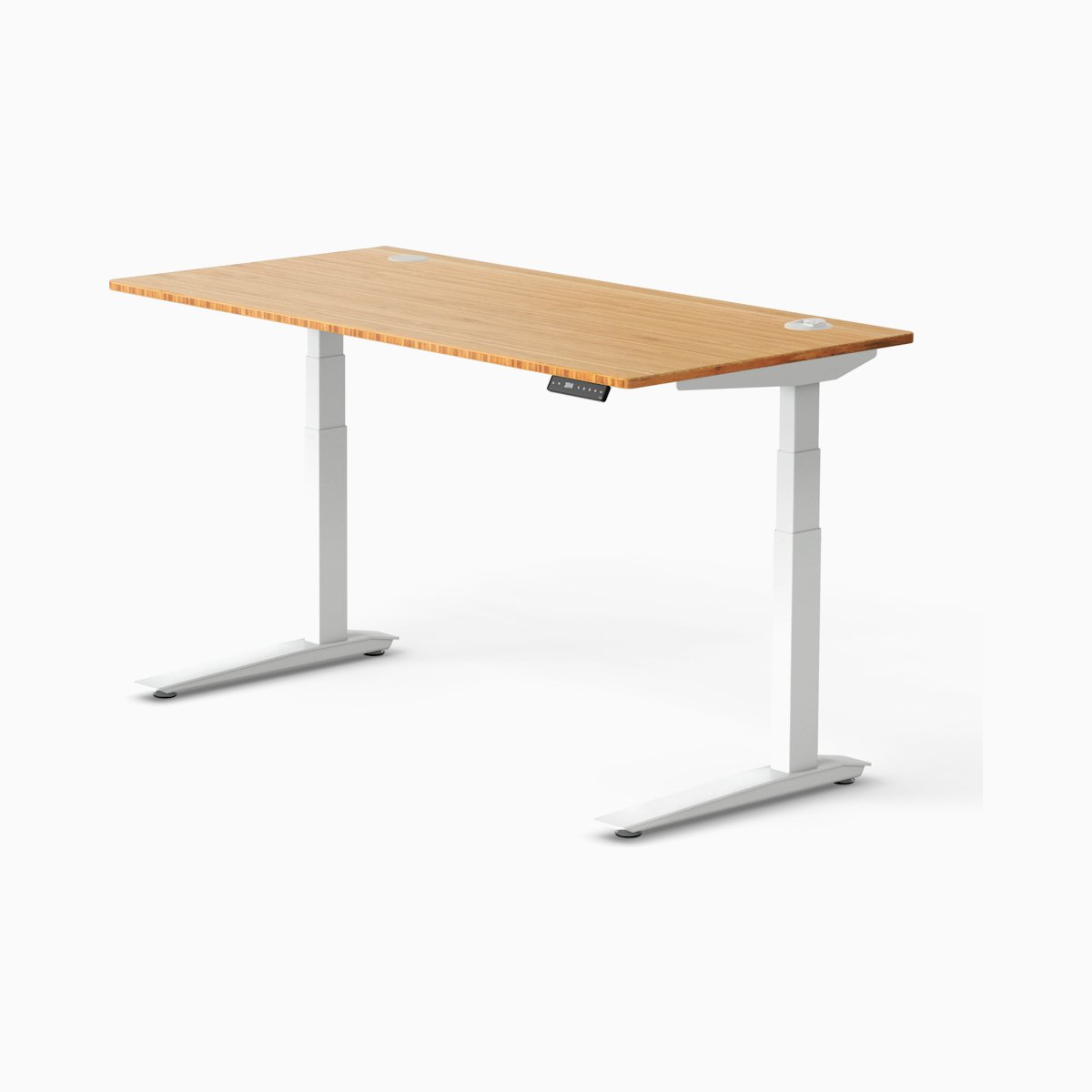
UPLIFT V2
$599–799
- Motor noise: ~42dB
- Transition speed: ~3.5s
- Wobble at max height: Minimal
The V2 measures approximately 42dB at ear level—not silent, but the tone is low and even. It's the difference between a refrigerator hum and a fluorescent light buzz. The refrigerator fades into background. The fluorescent light does not. The V2 motor sits firmly in the former category.
The transition runs about 3.5 seconds from seated to standing height. That's fast enough that the movement feels like a decision rather than a negotiation. The control panel has four physical preset buttons with genuine tactile feedback—they click, they register, and you can find them by touch without redirecting your attention from the screen. For anyone who's tried to hit a preset mid-focus only to accidentally trigger a different height, that tactile clarity is not a small thing.
At standing height, the V2 is genuinely stable. With a 30-pound desk load and light pressure at the front edge, there's no perceptible flex. The frame is well-engineered, and it shows in the way the desk feels when you lean on it—solid without being heavy or industrial. The laminate surface has a smooth, consistent texture that doesn't create any sensory friction. The edge is cleanly finished with no rough spots or hard corners.
The reason the V2 earns our top overall pick is that it scores well across every dimension without significant compromise in any of them. It won't be the cheapest option, but it's the one where you're unlikely to discover an irritant six weeks in.
View on AmazonFlexiSpot E7 Pro
FlexiSpot E7 Pro
$449–599
- Motor noise: ~41dB
- Transition speed: ~4s
- Wobble at max height: Minimal
The E7 Pro's frame is as stable as the V2 at $150 less. Equal or better rigidity at standing height, same minimal wobble profile, comparable build quality. Motor noise sits at approximately 41dB—tonally similar to the V2, low-frequency register, imperceptible difference in practice.
Where the E7 Pro loses ground is the control panel. The buttons have a softer, mushier press than the V2's controls—less tactile confirmation that the press registered. The panel layout is also busier, with more indicators and labels competing for visual attention. For people who rely on sensory cues to navigate their environment without thinking, the ambiguity of a soft button press adds a small but real cognitive tax.
There's one specific issue worth flagging: the keypad lock feature is easy to activate accidentally, particularly during transitions when you might brush the panel. When the lock engages, the desk stops responding and the panel shows a lock icon. The first time this happens—especially if you're mid-task and need to switch positions—it creates exactly the kind of moment of confusing friction that derails focus. It's solvable once you know about it, but it shouldn't require a trip to the manual.
View on AmazonFully Jarvis
Fully Jarvis
$449–649
- Motor noise: ~44dB
- Transition speed: ~3s
- Wobble at max height: Slight at max
The Jarvis has the simplest control panel of any desk we tested. Up button, down button, four preset buttons, nothing else. There are no status indicators competing for attention, no lock modes, no USB charging ports embedded in the panel adding visual clutter. If cognitive load during transitions is the thing you're optimizing against, this is your desk.
It's also the fastest in this group, completing the sit-to-stand transition in approximately 3 seconds. That speed matters more than the number suggests. When the body sends a "need to move NOW" signal, a 3-second transition gets honored. An 8-second transition gets skipped. The Jarvis earns its Strong rating on restlessness management partly because using it is genuinely low-friction.
The tradeoff is motor noise. At approximately 44dB, the Jarvis is louder than the other desks here—and the tone sits at a slightly higher frequency. It's not dramatic, but it's above the threshold where the motor noise fades into background. Some people won't notice or won't care. Others will notice immediately and find it distracting for the 3 seconds it runs. If you're sensitive to higher-frequency sounds, that's a real concern. If you're mostly sensitive to sustained low hum and the brief burst of motor sound during transitions doesn't bother you, the Jarvis is fine.
There's also slight wobble at maximum height under load—perceptible when leaning on the front edge, less noticeable during normal use. It's a structural characteristic of the lighter frame, not a defect. The bamboo surface option is worth considering if you're ordering: the texture is warmer and more consistent than the laminate, and it's the one surface on any of these desks that feels genuinely pleasant to rest your wrists against.
View on AmazonUPLIFT V2 Commercial
UPLIFT V2 Commercial
$849–1099
- Motor noise: ~38dB
- Transition speed: ~3.5s
- Wobble at max height: None
Zero wobble. At any height, under any reasonable desk load, the V2 Commercial doesn't move. Lean on the front edge, type aggressively, shift your weight—the desk doesn't respond. The heavier-gauge steel frame eliminates structural instability as a variable entirely.
The motor runs at approximately 38dB at ear level. That's not a rounding difference from the standard V2's 42dB—it's meaningfully quieter, and it's the number we'd quote if someone asked "which standing desk motor is the least likely to interrupt my thinking." In a quiet home office, the V2 Commercial is close to imperceptible during transitions.
The control panel is identical to the standard V2—same tactile presets, same layout, same clear feedback. UPLIFT didn't change what was already working.
The premium is real: $849–1099 versus $599–799 for the standard V2. Whether it's worth it depends on how much the motor noise and frame stability differences matter to you specifically. If you're spending 6+ hours a day at this desk and you know sensory distractions compound your fatigue, the quieter motor and zero-wobble frame are not abstractions. If you're working in a louder environment where 42dB versus 38dB is irrelevant, save the money.
View on AmazonBottom Line
If you're shopping now, here's the short version: buy the desk whose sensory tradeoff matches the way you actually work.
UPLIFT V2 — the default pick. No significant compromise in any dimension. Fully Jarvis — simplest controls, fastest transition, louder motor. FlexiSpot E7 Pro — V2-quality frame at $150 less, mushier control panel. Learn the keypad lock reset before you need it. UPLIFT V2 Commercial — the quietest, most stable option; the premium over the standard V2 is real, not marketing.
Most buyers should start with the UPLIFT V2. If motor noise and max-height stability are mission-critical, move up to the UPLIFT V2 Commercial. If budget matters more than panel feel, the FlexiSpot E7 Pro closes most of the gap for less money.
If you want to build the rest of the room around the desk, the ADHD home office setup guide covers the rest of the system.