Ergonomic Chairs for Sensory-Sensitive Workspaces
This site contains affiliate links. If you purchase through our links, we may earn a commission at no extra cost to you. We only recommend products we'd use ourselves.
The part of ergonomic chair coverage that never makes it into mainstream reviews: what the fabric feels like at hour four. The way the seat edge cuts across the back of your thighs when you're locked into something. The creeping discomfort of a lumbar support positioned 2 centimeters too high that you can't figure out how to fix without stopping what you're doing and reading a manual. These aren't edge cases—for sensory-sensitive people, they're the whole story.
We also tested for something else mainstream reviews ignore entirely: how well these chairs accommodate the way neurodivergent people actually sit. Cross-legged on the seat. Sideways. Kneeling with one knee up. Perched on the front edge. The ergonomics industry has spent decades optimizing chairs for one sitting position. Most of us don't use it.
Four chairs reviewed here. Two mesh, one upholstered fabric, one leatherette. Price range from $449 to $1,795. The gaps between them are real and specific, not marketing distinctions. The right pick comes down to heat, texture, movement, and how much setup overhead you want in an eight-hour day.
What We Tested For
Fabric and mesh texture over sustained contact, adjustment count versus adjustment intuitiveness, seat pan shape for unconventional positions, audible noise with movement, and heat management. Our full methodology is at Our Framework. The key thing here: adjustment count and adjustment cognitive load are not the same measurement. A chair with 12 settings you can dial in once and forget is different from a chair with 12 settings you'll keep second-guessing.
Quick Comparison
| Chair | Price Range | Seat Surface | Adjustments | Unconventional Positions | Chair Noise | Best For |
|---|---|---|---|---|---|---|
| Herman Miller Aeron | $1,395–1,795 | Pellicle mesh (back + seat) | 9+ manual | Limited—upright-focused | Near-silent | Sensory-sensitive / heat-intolerant |
| Herman Miller Cosm | $1,295–1,695 | Mesh back, knit seat | Minimal—auto-adjusting | Moderate | Near-silent | Low executive-function overhead |
| Steelcase Leap | $1,039–1,599 | Upholstered fabric | Many but intuitive | Good—wider seat helps | Slight creak after 6+ months | Movement-friendly, fabric preferred |
| Secretlab Titan Evo | $449–599 | Leatherette | Few, simple | Excellent—wide flat seat | Near-silent | Cross-legged / unconventional sitters |
Herman Miller Aeron
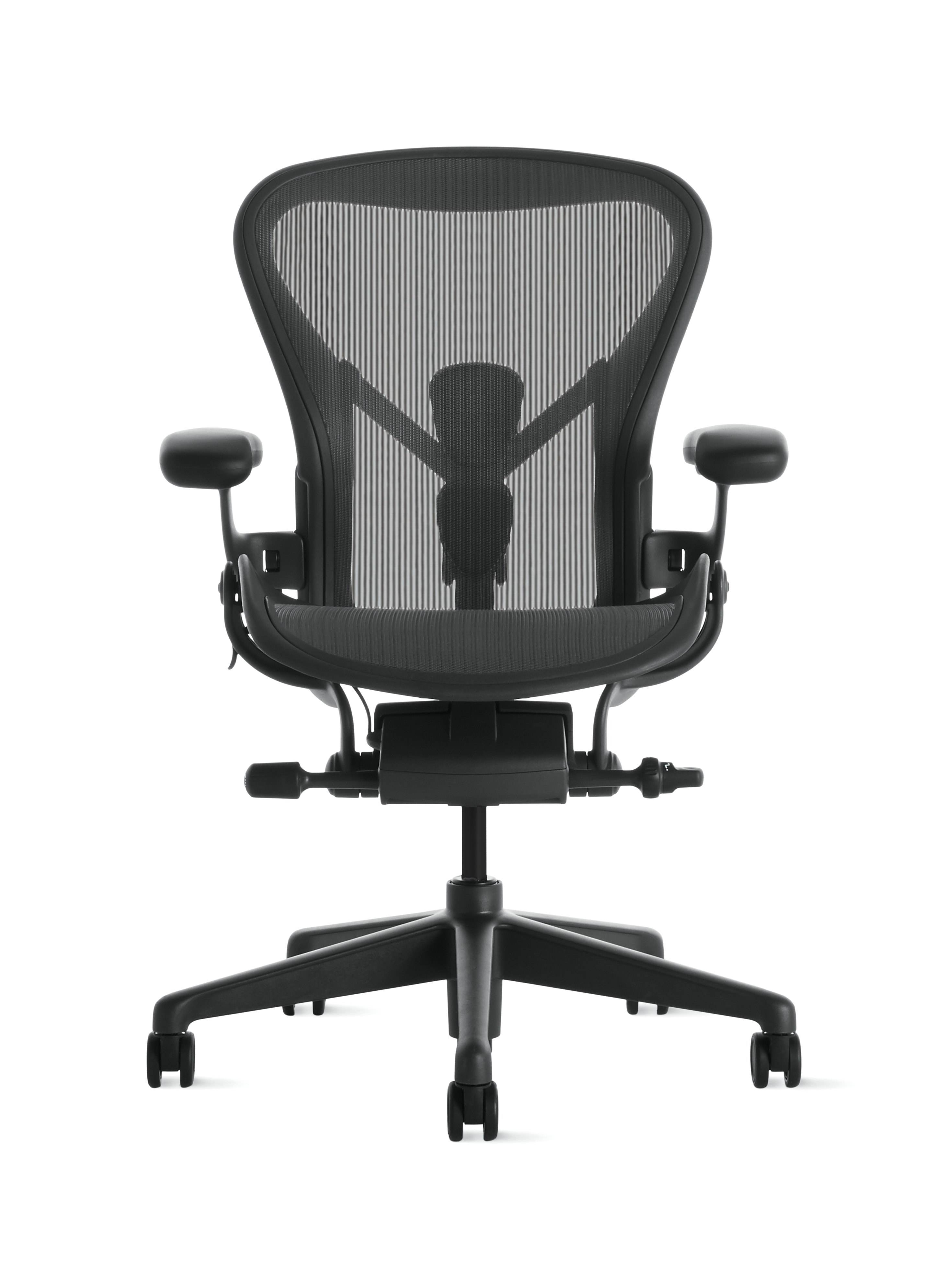
Herman Miller Aeron
$1,395–1,795
- Surface: Pellicle mesh
- Adjustments: 9+
- Airflow: Excellent
The Aeron's pellicle mesh—the woven surface on both the back and seat—is the thing that makes it worth considering at this price. Mesh chairs often look identical in photos but feel very different under sustained contact. The Aeron's pellicle has a smooth, almost neutral texture. It doesn't catch on clothing, doesn't create hot spots, and doesn't develop that tacky sensation that some mesh surfaces acquire after an hour of use. For people who run warm or who find heat accumulation a significant sensory trigger, that airflow advantage over upholstered chairs is substantial. An upholstered chair traps heat. The Aeron doesn't.
The arm pads are firm rubber, not soft foam or gel. They provide a stable, predictable surface that doesn't compress unpredictably under your forearms. That difference matters more than the photos suggest.
Where the Aeron is genuinely complicated: nine-plus manual adjustments. PostureFit SL, arm height, arm width, arm pivot, arm depth, tilt tension, tilt limiter, seat height, forward tilt. Each one involves a different lever or knob in a slightly different location. The initial setup experience requires cognitive engagement most of us would rather spend elsewhere. Once configured, you're done—the chair holds its settings. But getting there is a real task, and the reward for doing it carefully is not immediately obvious.
The Aeron is designed for upright sitting. The seat pan is shaped for it, and the lumbar support assumes it. Cross-legged sitting is possible but awkward—the seat edge doesn't accommodate it well, and you'll feel the frame's geometry working against you within minutes. If you regularly sit in unconventional positions, the Aeron will resist that rather than accommodate it.
View on AmazonHerman Miller Cosm
Herman Miller Cosm
$1,295–1,695
- Surface: Knit suspension
- Adjustments: 2 (auto-tilt)
- Airflow: Good
The Cosm's defining feature is its auto-harmonic tilt: the chair reads your body weight and movement and adjusts its recline tension automatically. You sit down and lean back and the chair responds. There's nothing to configure, nothing to tune. For anyone who has spent 20 minutes adjusting tilt tension on an office chair only to find it still doesn't feel right, the Cosm's approach is a genuine relief. The chair just works in the background, which is exactly where you want it.
The manual adjustment list is short by design. Seat height and arm position—that's essentially it. Compared to the Aeron's nine-plus controls, this is a meaningfully different cognitive relationship with the furniture. You're not maintaining a configuration. You're just sitting.
The mesh back and knit suspension seat provide good airflow, though slightly less than the Aeron's pellicle. The knit seat surface has a softer initial texture, with more give underhand and slightly more tactile presence than the Aeron's smooth mesh. Neither is rough or problematic, but the difference matters if material texture is a major sensitivity point. The Cosm's knit also retains slightly more warmth than the Aeron's pellicle, while still outperforming any upholstered option for airflow.
The tilt range on the Cosm is wider than the Aeron's, and the auto-adjustment means it responds smoothly when you shift between leaning forward and reclining. For people who move frequently during work—fidgeting, adjusting, changing angles without fully changing positions—the Cosm handles those micro-movements better. It's not designed for cross-legged sitting any more than the Aeron is, but it's more accommodating of general restlessness.
View on AmazonSteelcase Leap
Steelcase Leap
$1,039–1,599
- Surface: Upholstered fabric
- Adjustments: 10+ (intuitive)
- Airflow: Low
Choosing fabric or mesh isn't purely aesthetic—it's a genuine sensory decision. The Leap is upholstered, which means it doesn't have the airflow properties of either Herman Miller chair. But for people who find mesh textures uncomfortable, or who sit in environments cool enough that heat accumulation isn't a concern, the Leap's fabric surface feels warmer and softer under sustained contact. The specific texture depends on which material you order. The standard upholstery options have a consistent weave without rough patches or hard seams; the chair edge is rounded and doesn't dig.
The Leap's LiveBack system is the technical differentiator: the backrest flexes to follow your spine through different postures rather than holding one fixed position. When you lean forward to focus, it follows. When you lean back, it follows. This matters for people who move through different postures during a workday—the chair doesn't fight the movement, it accommodates it. Combined with a wider seat than either Herman Miller, the Leap gives you more room to adjust your position without fully repositioning in the chair.
The adjustment count is high—comparable to the Aeron—but the design is more intuitive. Most controls are directly on the seat edges or arms, labeled clearly, with a logical relationship between control location and what they change. Lower back firmness is adjusted at lower back height; upper back force is controlled separately. You can dial this chair in without a manual if you take ten minutes to methodically work through each control. That's a real distinction from chairs where the adjustments feel arbitrary until you've read the documentation.
One issue that surfaces after extended use: the Leap develops a slight creak, typically around the six-month mark. The sound emerges during lateral weight shifts and tilt changes, and it reads more like structural settling than mechanical failure. Treat it as a known characteristic of the chair rather than a red flag.
View on AmazonSecretlab Titan Evo
Secretlab Titan Evo
$449–599
- Surface: Leatherette
- Adjustments: 5 (simple)
- Seat width: Extra wide
The Titan Evo's seat is notably wide and flat compared to every other chair in this review. That's the reason to consider it. If you sit cross-legged, tuck one foot under yourself, perch sideways, or regularly end up in positions that ergonomics marketing pretends don't exist—this is the chair designed to accommodate that rather than fight it. The flat seat pan doesn't funnel you toward a single correct position. The extra width gives you room to move without constantly sensing the chair's edges. For people whose bodies need to shift frequently to stay regulated, that physical latitude is functional, not a luxury.
The adjustment set is deliberately minimal: seat height, recline angle, armrest position in four directions. That's the full list. The controls are clearly labeled and behave predictably. There's no configuration complexity to navigate, which makes the chair easy to set up and easy to hand off if someone else uses your space.
The leatherette surface starts cool and warms to body temperature over the first 20 to 30 minutes of use. That transition is noticeable every time you sit back down after a break, and on humid days or in warm rooms the material retains more moisture than mesh. Buy this chair for the wide seat and movement freedom, not for thermal neutrality.
The lumbar pillow is magnetic, which means it's removable and repositionable without tools. It snaps onto the seatback and holds position during normal use. The feel is firmer than it looks—it provides real support rather than decorative padding. For people who need lumbar support at a specific height that fixed lumbar systems never quite hit, the adjustability is genuinely useful. For people who don't use lumbar support at all, it comes off cleanly.
View on AmazonBottom Line
Chair fit compounds faster than almost any other workspace decision, so the right pick comes down to what you need the chair to do by hour four, not minute four.
Herman Miller Aeron is the top pick when airflow and heat management matter most. Herman Miller Cosm is the cleanest buy when you want mesh benefits without a setup project. Steelcase Leap is the strongest fabric option if you want a chair that moves with you. Secretlab Titan Evo is the right answer when cross-legged or sideways sitting is non-negotiable and you want more room at a lower price.
The chair is one piece. If you're building a workspace from scratch, the sensory-friendly workspace guide covers how the full environment interacts—because the best chair in the room doesn't matter much if the lighting or acoustics are the actual problem.